


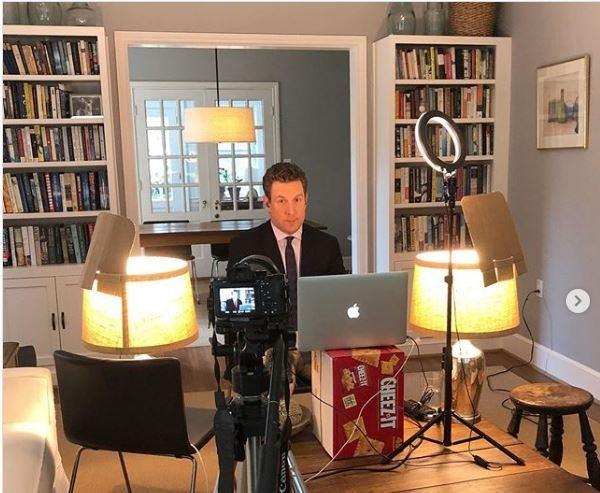
Deep into a prolonged lockdown, NewsHour team adapts to keep the cameras rolling
Political acrimony and a stubborn pandemic promise chaos this election season.
COVID-19. Lockdown. West Coast wildfires. A presidential election in a nation more politically riven than since the Civil War, some say. Does anyone remember a year like 2020? And is there a public television news viewer who can make out anything but a fuzzy screen and static noise beyond Election Night 2020, the vanishing point of our current horizon? We wonder.
And if you’re a television news producer, you’re now more likely to be putting a lot of energy into simply keeping your head above the rough waters.
Journalists at PBS’ flagship news show, the NewsHour, have been on our minds. If anything, the makeshift newscasting has gotten more intense than the early days of the pandemic, when we explored how they kept the show going from their homes. It was back when we all thought we’d be working face-to-face again by the fall.
But this is the new normal, and likely for some time to come.
The NewsHour team must prepare for an election night that is unlikely to produce a clear winner, using a vastly changed playbook on an unfamiliar field, and in most cases, do this in isolation, usually from home. For some, the jury-rigging includes a Cheez-Its box as a monitor stand, while a family member operates the camera (see PBS NewsHour correspondent William Brangham’s Instagram account).
Last month’s two political party conventions — an unprecedented national experiment in virtual conventioneering — made us wonder anew how NewsHour producers and correspondents have managed to cover this election season and a mind-boggling slate of national news. They covered the conventions without the red, white and blue balloon drops; the crowd pans and other visuals; the noise; the spontaneous interviews and the physical proximity that one would assume is necessary to any televised production.
So, we caught up with NewsHour Executive producer Sara Just and the show’s senior director of brand strategy and communications, Nick Massella. We got a chance to run many of our curious questions by them.
Who does the camera work? Do the NewsHour anchors work from their homes and are any crew present for lighting, camera, makeup, etc.?
Nick Massella: Most do their own, with the exception of Judy (Woodruff), who has some production support on site during broadcast.
How many people are present at the Arlington, Va., studio on a typical production day?
NM: On a typical day, with Judy anchoring from her home, there are fewer than 15 persons (editorial and technical) working on site at our Arlington studio and control room. This number grew during our two weeks of convention programming (24+ hours of live television over two weeks).
When was the last time you saw everyone in one place? We might assume that it has been since March or April, but have you had occasion to meet in person, relying on masks/social distancing? Or... have you been able to accomplish everything you want "virtually"?
NM: If Zoom and Teams meetings don't count, March 10, to be exact.
What are the most notable technical and logistical challenges that you have experienced?
Sara Just: It has been an enormous challenge, especially since we had to make critical production changes while staying on the air each night. I compare it to trying to tie your shoelaces while riding a bike. Our wonderful producers and WETA engineering teams have come up with incredible solutions to our puzzles and have continued to tweak and improve our arrangement every week.
On a given day, you normally talk and meet with dozens of people. How does that now work in a pandemic?
SJ: One of the biggest challenges remains communications. So many of the conversations that were so easy to have with multiple people for instance, when there is breaking news just minutes to air, for instance, are more cumbersome and laborious. But we’re developing new habits and making it work. Most of all we miss seeing each other.
In producing the NewsHour under the circumstances of the COVID-19 pandemic, what has worked well? Have you discovered anything that hasn’t worked as planned?
SJ: More generally we’ve learned that we can reach a number of people for interviews in far-flung places with a series of Skype interviews that might have taken hours or even days to accomplish in our traditional format when we often put producers, correspondents, camera crews on planes to get to a location, set up cameras and lights and more. The Skype interviews may not always have the same clarity of video or sound, but we think the audience understands under these circumstances. We expect we will keep doing some interviews in this new way going forward, even after the pandemic ends.
Have you ever had any situation that prepared you for the current environment?
SJ: This has truly been like nothing else.